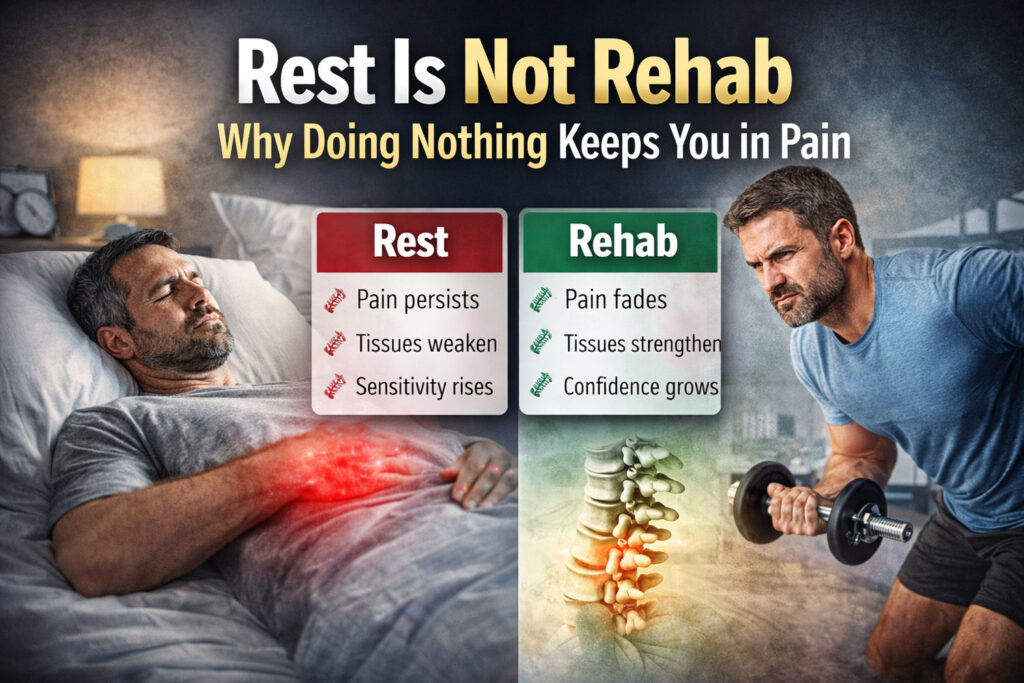
Rest Is Not Rehab: Why Doing Nothing Keeps You in Pain
By Super Myo | Allied Health Professional & Manual Therapy Truth-Teller Who Keeps it Real!
Let’s Kill This Myth Early
Rest does not fix pain.
It might reduce symptoms short term, but if rest was the answer, nobody would still be sore weeks, months, or years later.
Yet this is still the advice people get over and over again.
“Just rest it.” “Give it time.” “Let it settle.”
And people listen. They stop moving. They avoid load. They wait.
Then they wonder why everything hurts the moment they try to live normally again.
Why Rest Feels Like It Helps at First
When you stop moving, pain often eases. That’s not because healing magically happened. It’s because you removed the demand.
Less load means fewer signals going through an already sensitive system.
So yes, rest can calm things down temporarily.
But calm is not the same as strong. And quiet is not the same as resilient.
The problem starts when rest becomes the strategy instead of the reset.
What Actually Happens When You Rest Too Long
The body runs on a simple rule: use it or lose it.
When you stop loading tissues, several things happen:
- Muscles weaken
- Joints stiffen
- Movement confidence drops
- Load tolerance shrinks
At the same time, the nervous system becomes more sensitive, not less.
Now you’ve got a body that can handle less stress than before, paired with a nervous system that reacts faster and louder.
That’s not healing. That’s deconditioning.
Why Pain Comes Back the Moment You Move Again
This is the part that frustrates people the most.
They rest for weeks. Pain settles. They think it’s gone.
Then they bend over, train, lift, or sit for a long day, and bang. Pain is back.
Not because something was re injured, but because the system was never rebuilt.
You removed the load, but you never retrained the capacity.
Pain is not just about damage. It is about tolerance.
If your body cannot tolerate normal life demands, pain will show up to tell you that.
Rest vs Rehab: They Are Not the Same Thing
Rest is passive.
Rehab is active.
Rest avoids stress. Rehab teaches the body how to handle it again.
Good rehab does not mean smashing yourself or pushing through pain blindly. It means gradually reintroducing load in a way the nervous system feels safe with.
That is how confidence returns. That is how tissues adapt. That is how pain loses its grip.
The Nervous System Angle Nobody Explains
Pain is not just happening in muscles or joints. It is being produced by the nervous system.
When you rest too much, the nervous system never gets evidence that movement is safe again.
So it stays protective.
Every movement feels risky. Every sensation is amplified. Every flare up confirms the fear.
Rehab gives the nervous system proof that the body can move, load, and adapt without danger.
That is how sensitivity reduces.
Why “Just Resting” Often Leads to Chronic Pain
Most chronic pain stories start the same way.
An initial injury. A period of rest. A return to activity that hurts. More rest. More fear.
Months later, the tissue has healed, but the pain hasn’t left.
Not because the body failed, but because it was never reconditioned.
Pain became the problem instead of the signal.
What Smart Recovery Actually Looks Like
Recovery is not doing nothing. It is doing the right things at the right time.
That means:
- Reducing load when tissues are overwhelmed
- Reintroducing movement early and safely
- Gradually increasing strength and tolerance
- Calming the nervous system through education and hands on input
- Restoring confidence in movement
This is where hands on therapy, guided movement, and proper explanation matter.
Not because they fix anything, but because they help the system reset and rebuild.
Why People Stay Stuck in the Rest Cycle
Because rest feels safe.
Movement feels risky when pain has been hanging around.
And because many people are never shown how to move again properly, rest becomes the default.
But safety is not the same as progress.
Avoidance keeps pain quiet. Exposure changes it.
The Hard Truth About Pain and Recovery
Pain does not disappear just because time passes.
It changes when the system adapts.
And adaptation requires input.
Rest alone does not build strength, tolerance, or confidence. It delays them.
A Final Word from Super Myo
If rest truly fixed pain, you wouldn’t still be dealing with it.
Your body is not fragile. It just hasn’t been rebuilt yet.
The goal is not to avoid movement forever. The goal is to return to it smarter, stronger, and with less fear.
Pain doesn’t leave when you stop moving.
It leaves when your body learns it can move safely again.
That is rehab. Not rest.
Frequently Asked Questions
Should I rest completely when I am in pain?
Short term rest can help calm symptoms, but complete rest for long periods usually delays recovery.
Can movement make pain worse?
Unplanned or excessive load can flare symptoms, but graded movement helps rebuild tolerance and confidence.
What is the difference between rest and rehab?
Rest avoids stress. Rehab reintroduces stress in a controlled way so the body adapts safely.
Why does pain come back after resting?
Because the system was never rebuilt to handle normal demands, so sensitivity remains high.
How long does rehab take?
It depends on the person, but progress usually comes faster when movement is reintroduced early and consistently.