Seeing a Physio Three Times a Week: Rehab or Dependency?
By Super Myo | Allied Health Professional & Manual Therapy Truth-Teller Who Keeps it Real!
Let’s clear something up that a lot of people are quietly thinking but don’t feel confident enough to say out loud.
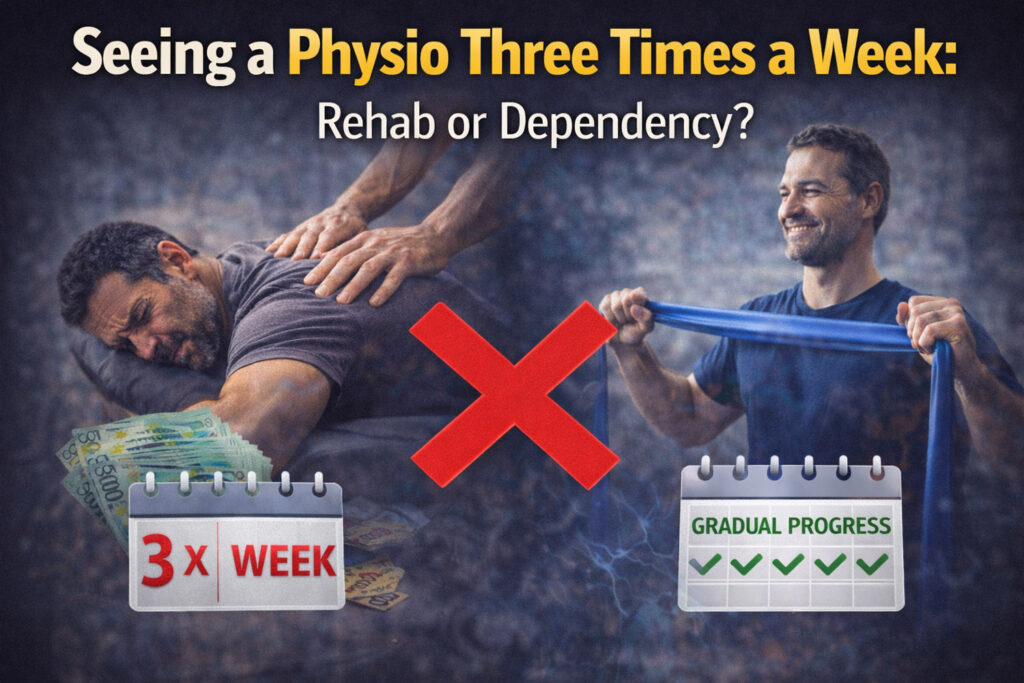
If you’ve been seeing a physio three times a week for months and nothing is actually changing, that’s not rehab. That’s a payment plan.
Real rehab has a very specific goal: to make you less reliant on treatment over time, not more. If the plan only works when you keep showing up indefinitely, something is off.
And no, this isn’t an attack on physiotherapy as a profession. There are excellent physios out there doing proper work. This is about a system that quietly rewards dependency instead of independence.
How Rehab Is Supposed to Work
Good rehab follows a simple trajectory.
At the start, you might need more hands-on support. Pain is high. Confidence is low. Movement feels unsafe. Fair enough.
But as treatment progresses, a few things should happen:
- Pain should reduce or at least become more predictable.
- Movement should feel safer and more controlled.
- Your understanding of what’s going on should improve.
- Your reliance on the therapist should decrease.
The end goal is not “ongoing treatment”. The end goal is capacity. Strength. Confidence. Control.
If weeks go by and the only thing that changes is your bank balance, you’re not rehabbing. You’re maintaining a business model.
Why Three Times a Week Becomes the Default
Here’s why this pattern shows up so often.
Short appointments don’t leave room for proper assessment, education, or progression. So instead of one solid session, people are booked in repeatedly to compensate for lack of depth.
There’s also fear-based language at play:
- “If you stop coming, it’ll flare up.”
- “You need consistency or you’ll undo the progress.”
- “Your body needs ongoing support.”
That sounds responsible on the surface, but it subtly shifts the message from “you’re getting stronger” to “you’re fragile without us”.
That’s not empowering. That’s conditioning.
Pain Does Not Mean You Need Constant Treatment
Pain does not automatically mean something is damaged or unstable.
In many cases, pain is a sign of sensitivity, not weakness. The nervous system has learned to be protective. It’s loud, not broken.
Constant passive treatment can actually reinforce that sensitivity by teaching the body that relief only comes from external input. The moment that input stops, the system panics again.
That’s why some people feel worse the moment they miss a session. Not because they’ve regressed, but because they’ve never been taught independence.
What Real Progress Actually Looks Like
Real progress often looks less dramatic than people expect.
It looks like longer gaps between appointments. It looks like symptoms that flare less intensely. It looks like confidence returning before pain fully disappears. It looks like you needing reassurance less often.
If your therapist isn’t actively working towards spacing sessions out, that’s a red flag.
You don’t build resilience by outsourcing your body’s job forever.
The Difference Between Support and Dependence
Support is temporary. Dependence is indefinite.
Support says, “Here’s what’s happening, here’s how we calm it down, here’s how you take over.” Dependence says, “You need me to keep this under control.”
One builds capacity. The other builds fear.
And fear is incredibly effective at keeping diaries full.
Why Independence Is the Marker of Good Therapy
The best compliment a therapist can receive isn’t “I need to see you every week forever”.
It’s “I don’t need you as much anymore, but I know what to do if things flare”.
That’s success.
That’s someone who understands their body, trusts it again, and has tools instead of anxiety.
What a Smarter Approach Looks Like
A smarter approach doesn’t rush people out the door, but it also doesn’t trap them in a loop.
It focuses on:
- Explaining pain clearly, without catastrophising.
- Using hands-on work to reduce threat, not create reliance.
- Building load tolerance gradually.
- Progressing movement instead of avoiding it.
- Reducing appointment frequency as capacity improves.
Sometimes that means one session a week initially. Sometimes it means one session every few weeks. Sometimes it means you don’t need another session at all.
The point is that the plan adapts as you do.
The Hard Truth Most Clinics Won’t Say
If you’ve been told you need three sessions a week indefinitely, ask a simple question.
“What’s the exit plan?”
If there isn’t one, that tells you everything.
Pain recovery is not about attendance. It’s about adaptation.
And if your treatment only works when you’re constantly plugged into it, it’s not doing its job.
Final Word
Your body is not a subscription service.
Good therapy gives you confidence, not dependence. Strength, not fear. Understanding, not confusion.
If you’re improving, you should be needing less, not more.
That’s not anti-therapy. That’s pro-rehab done properly.