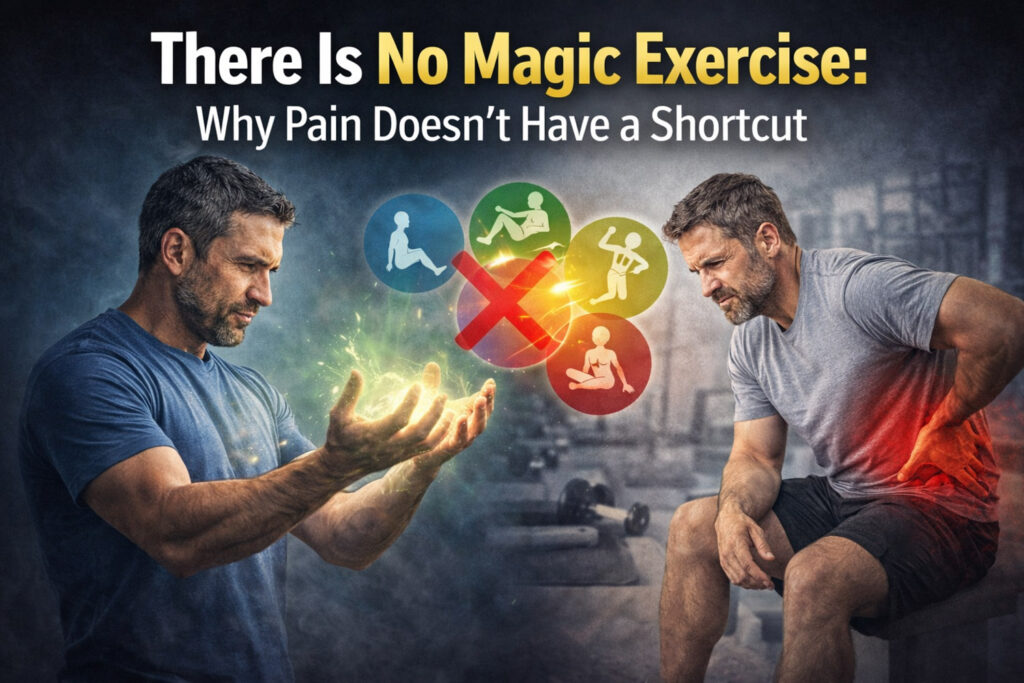
There Is No Magic Exercise: Why Pain Doesn’t Have a Shortcut
By Super Myo | Allied Health Professional & Manual Therapy Truth-Teller Who Keeps it Real!
If there was one magic exercise that fixed pain, Western Sydney would be full of pain-free legends.
Every gym would have it written on the wall. Every physio would prescribe it. Every Instagram reel would end with “do this once a day and you’ll never hurt again.”
But here we are.
People are still sore. Still stiff. Still chasing the next miracle movement that promises relief and delivers nothing lasting.
So let’s clear this up properly.
There is no magic exercise.
And believing there is one is one of the biggest reasons people stay stuck.
Where the “Magic Exercise” Myth Comes From
The idea is tempting because it feels hopeful.
One stretch. One drill. One activation exercise. One secret movement nobody told you about.
It’s far easier to believe pain has a simple fix than to accept that recovery takes time, consistency, and capacity.
The fitness and rehab industries feed this idea because it sells. “Do this for your glutes.” “Fix your back in five minutes.” “Unlock your hips instantly.”
Short clips. Big promises. No context.
Pain doesn’t work like that.
Pain Is Not a Skill Issue
Most people think pain means they’re doing the wrong exercise.
In reality, pain is rarely about doing the wrong thing. It’s usually about asking too much of a system that isn’t ready.
Pain is a load tolerance problem, not a technique problem.
You can perform the “perfect” exercise and still flare up if your tissues and nervous system cannot handle the load you’re placing on them.
That’s why people say:
- “I did the exercises exactly like they showed me and it still hurt.”
- “I felt better for a day, then it came back.”
- “I’ve tried everything.”
They haven’t failed. The approach has.
Why Exercises Work, Sometimes
Exercises are not useless. They just get over-credited.
An exercise can help when it:
- Builds strength in under-loaded tissues
- Gradually increases tolerance to movement
- Restores confidence in the body
- Is dosed correctly for the person doing it
An exercise fails when it’s treated like a cure instead of a tool.
Doing clamshells won’t fix back pain if your nervous system is constantly on high alert.
Stretching won’t solve tight hamstrings if your body is guarding due to fatigue or stress.
Core exercises won’t help if you’re bracing all day and never letting things relax.
Context matters more than the movement itself.
Why Pain Moves Around When You Chase Exercises
A common pattern looks like this:
Back hurts. You’re told to strengthen your glutes. Your back improves slightly. Now your hip hurts. You’re told to stretch your hip flexors. Your hip settles. Now your hamstring flares.
That’s not bad luck.
That’s the system shifting stress around because capacity hasn’t increased overall.
You’re plugging holes instead of raising the waterline.
Pain Is a Nervous System Conversation
Here’s the part most people miss.
Pain is not just about tissues. It’s about how your nervous system interprets threat.
If your brain thinks movement is risky, it will amplify signals.
If it thinks you’re overloaded, it will tighten muscles.
If it thinks you’re exhausted, stressed, or under-recovered, it will lower tolerance.
You cannot out-exercise a nervous system that feels unsafe.
This is why hands-on treatment, education, and gradual exposure matter. They lower threat so movement can actually do its job.
Why People Feel “Activated” But Not Better
Activation exercises feel productive.
You feel muscles working. You feel switched on. You feel like something is happening.
But activation without progression leads nowhere.
If you keep doing low-level exercises without increasing load, range, or complexity, your body never adapts. It stays cautious.
Feeling a muscle is not the same as making it stronger.
Burn is not the same as capacity.
Soreness is not progress.
What Actually Drives Long-Term Change
Real recovery follows boring principles.
- Gradual load increase
- Consistent exposure
- Adequate recovery
- Reduced fear around movement
- Strength built across ranges you actually use
There’s nothing sexy about it, but it works.
Exercises are part of the plan, not the plan itself.
Why One-Size-Fits-All Programs Fail
Generic programs ignore the most important variable.
The person doing them.
Two people can do the same exercise with completely different outcomes. One improves. One flares. One feels confident. One feels fragile.
That doesn’t mean one is broken.
It means their capacity, history, stress levels, sleep, and load tolerance are different.
Pain is individual. Treatment should be too.
Stop Chasing the Perfect Exercise
If you’re constantly searching for the next drill, the next stretch, the next activation trick, ask yourself this:
Have I actually built tolerance, or am I just managing symptoms?
Pain doesn’t disappear because you found the right exercise. It fades when your body trusts that it can handle life again.
That trust is built over time.
A Final Word from Super Myo
There is no magic exercise.
There is only the right input, at the right time, at the right dose, for the right person.
Exercises are tools, not cures.
Pain is not a failure of effort.
And progress is not instant.
Stop chasing shortcuts.
Start building capacity.
That’s how pain actually changes.
Frequently Asked Questions
Is there ever a “best” exercise for pain?
Some exercises are more appropriate for certain conditions, but there is no single exercise that fixes everyone. The best exercise is the one you can tolerate and progress consistently.
Why do exercises help for a day, then pain comes back?
Because relief and recovery are different. A movement can temporarily calm the system, but lasting change needs progressive loading, recovery, and consistency over time.
Should I stop exercising if I have pain?
Not usually. Most people need smarter movement, not zero movement. The goal is to reduce threat, improve tolerance, and build capacity gradually, not push through flare ups blindly.
Why do “activation” exercises feel good but not fix the issue?
Because activation is only a starting point. Without progression in load, range, and real-world movement, your body does not adapt and symptoms often return.
How long does it take to build real tolerance?
It depends on your starting point, stress, sleep, and training load. Most people notice meaningful change when they follow a consistent plan over weeks and months, not days.